

Where Does Fat Go When You Lose It?
Where Does Fat Go When You Lose It?
The Surprising Science of Fat Loss—and How VO₂ Max Changes the Game
Most people believe fat is burned by working up a sweat, or that it melts away through the skin. The truth is stranger—and more fascinating—than that. The vast majority of the fat you lose literally leaves your body through your lungs. And how efficiently that process works depends heavily on a single measurable number: your VO₂ max.
The Chemistry of Fat Loss: You Breathe It Out
When your body breaks down stored fat (triglycerides), the carbon atoms in those fat molecules get converted into carbon dioxide (CO₂). That CO₂ is transported through the bloodstream to your lungs and exhaled with every breath you take.
A landmark 2014 study published in the British Medical Journal put hard numbers on this:
| Where Does Fat Go? | |
|---|---|
| Exhaled as CO₂ (through your lungs) | 84% |
| Lost as water (sweat, urine, breath vapor) | 16% |
| Converted to heat or other energy forms | < 1% |
In other words: breathing is the primary exit route for body fat. Every exhale removes a small amount of carbon that was once stored in your fat cells. The more efficiently and deeply you breathe—and the more oxygen your body can process—the more fat you can metabolize.
What Is VO₂ Max—and Why Does It Matter for Fat Burning?
VO₂ max is the maximum rate at which your body can consume oxygen during intense exercise. Think of it as your aerobic engine size. A larger engine means:
- More oxygen delivered to your muscles per minute
- Greater ability to burn fat as fuel (especially at moderate intensities)
- Faster CO₂ clearance—meaning fat breakdown products leave your body more efficiently
- More total calories burned across the same workout
VO₂ max is measured in milliliters of oxygen per kilogram of body weight per minute (mL/kg/min). Here’s what the ranges look like for adults:
| VO₂ Max (mL/kg/min) | Fitness Category | Metabolic Implication |
|---|---|---|
| < 30 | Poor | Limited fat oxidation capacity |
| 30–40 | Below Average | Modest fat-burning potential |
| 40–50 | Average to Good | Solid aerobic base for fat loss |
| 50–60 | Very Good | High fat-burning efficiency |
| > 60 | Excellent / Athletic | Superior metabolic fat utilization |
The higher your VO₂ max, the more fat your body can oxidize—and exhale—per minute of activity.
The Fat-Burning Threshold: Why Intensity Matters
Here’s where it gets nuanced. Fat burning doesn’t happen equally at all intensities. Your body uses a mix of fat and carbohydrates for fuel, and that ratio shifts dramatically depending on how hard you’re working.
| Exercise Intensity | Primary Fuel | Fat % of Calories Burned |
|---|---|---|
| Rest / Very Light | Fat | ~85–90% |
| Zone 2 (60–70% max HR) | Fat + Some Carbs | ~65–75% |
| Zone 3–4 (70–85% max HR) | Mixed | ~40–60% |
| Zone 5 / HIIT (85%+ max HR) | Mostly Carbs | ~20–35% |
The sweet spot for fat oxidation is Zone 2—a conversational, steady pace where your body preferentially burns fat. But here’s the catch: what counts as Zone 2 is completely individual. Generic heart rate formulas ("220 minus your age") can be off by 10–20 beats, meaning you could be training in the wrong zone without knowing it.
How VO₂ Max Training Increases Fat Burning Over Time
Training to improve your VO₂ max creates lasting metabolic changes:
- More mitochondria. Mitochondria are where fat is actually burned. Higher VO₂ max correlates directly with greater mitochondrial density in muscle cells.
- Better fat enzyme activity. Your body upregulates the enzymes responsible for breaking down fat for fuel.
- Higher fat oxidation at rest. Fit individuals burn a larger proportion of fat even while sitting still.
- Improved CO₂ clearance. A stronger respiratory system exhales fat metabolites more effectively, keeping the fat-burning process running smoothly.
A 2023 meta-analysis found that individuals with higher VO₂ max lost significantly more body fat over 12–24 weeks of training compared to those with lower baseline aerobic fitness—even when caloric intake was matched.
Can You Measure Your Personal Fat-Burning Zones?
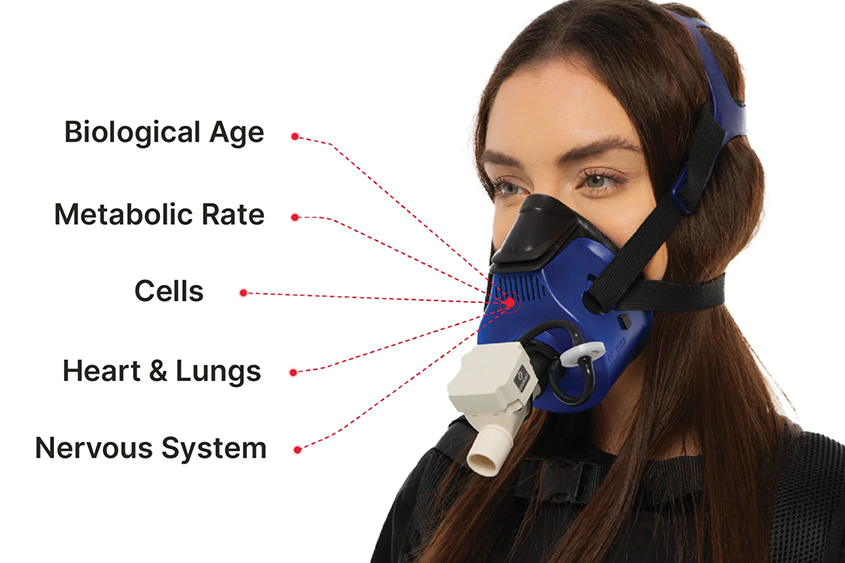
Yes—and this is where breath analysis becomes genuinely powerful. A metabolic breath test (also called indirect calorimetry or VO₂ testing) measures the oxygen you consume and CO₂ you produce breath-by-breath. From this data, clinicians can determine:
- Your exact VO₂ max
- Your personal heart rate zones (not estimated—measured)
- Your fat max zone—the specific heart rate where you burn the highest absolute amount of fat per minute
- Your respiratory exchange ratio (RER)—a real-time readout of whether you’re burning fat or carbs at any given intensity
Without this data, even a committed exerciser may be training in zones that minimize fat oxidation—working harder than necessary and getting less fat loss in return.
The Bottom Line
Fat loss is, literally, a respiratory process. Every time you exhale, you’re releasing the byproducts of fat metabolism. The more efficiently your body uses oxygen—as measured by VO₂ max—the more fat you can burn and breathe out during every workout and throughout your day.
Improving your VO₂ max isn’t just about athletic performance. It’s one of the most evidence-backed strategies for long-term metabolic health, body composition, and longevity.
Ready to find out exactly how your metabolism is working? Book your breath analysis today.


MAP
© 2026 Mind Body Spine Chiropractic. All Rights Reserved. Accessibility Statement - Privacy Policy - Terms and Services - Sitemap
Powered by: 