

Three Body Systems
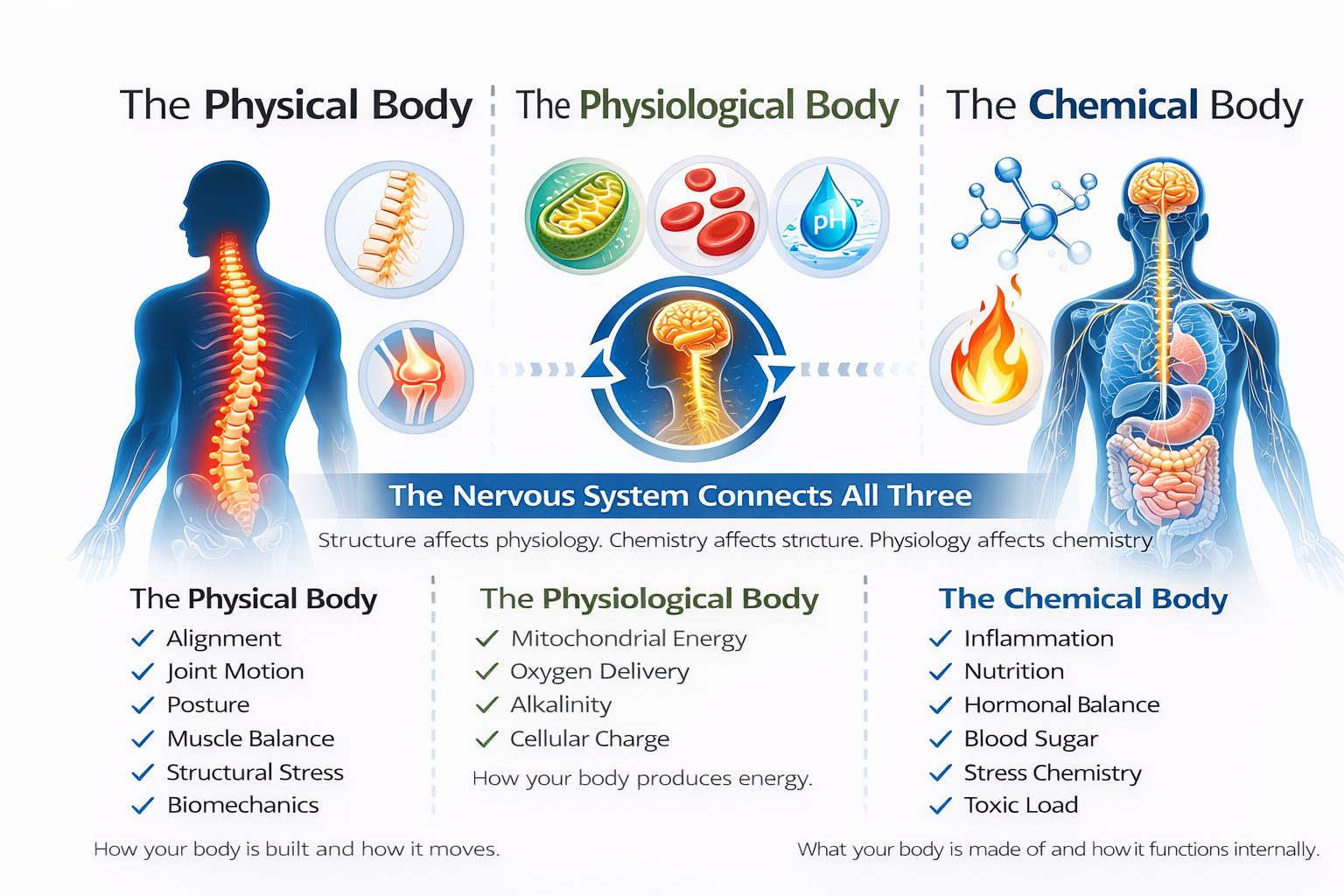
Your Body Has Three Layers — Are You Only Treating One?
Have you ever done everything right: stretched, rested, taken your supplements, and still felt like something was off? Or maybe you’ve had pain that no single treatment fully resolved? There’s a reason for that.
Your body isn’t one simple machine. It operates across three distinct but deeply connected layers: the physical, the physiological, and the chemical. When all three are balanced and communicating well, you feel vibrant, energetic, and pain-free. When even one of them is struggling, the rest begin to suffer too. At Mind Body Spine Chiropractic, this is the lens through which we look at every patient. Not just “where does it hurt?” but “which of your three body systems is out of balance — and why?”
Structure affects physiology. Chemistry affects structure. Physiology affects chemistry. You cannot fully heal one without addressing all three.
The Nervous System: Your Body’s Master Connector
Before we explore each of the three layers, there’s one system you need to understand first: your nervous system. Every signal that travels between your physical structure, your cellular
energy production, and your internal chemistry passes through it. Think of the nervous system as the master electrical grid of your body. When it’s working correctly, every organ, muscle, gland, and cell receives the signals it needs to function. When it’s compromised; by spinal misalignment, chronic stress, or poor posture, that communication breaks down, and all three body systems suffer. This is why spinal health is foundational to total body function, not just for back pain, but for everything.
Layer 1: The Physical Body — How You’re Built and How You Move
Your physical body is your structure: the bones, joints, muscles, fascia, posture, and movement patterns that determine how your body handles stress, load, and gravity every single day.
Think of your physical body as the scaffolding everything else is built on. When your spine is misaligned, a joint isn’t moving freely, or your posture is placing constant stress on the
wrong structures, it creates a ripple effect throughout your entire system. A pinched nerve from a misaligned vertebra doesn’t just cause local pain. That nerve may be controlling an organ, a muscle group, or a blood vessel. A tight hip flexor doesn’t just cause low back pain, it can alter your gait, compress your lumbar discs, and even affect how deeply you breathe.
Your physical body includes:
Spinal alignment and joint motion
Posture and muscle balance
Structural stress and load distribution
Biomechanics and movement patterns
If the structure is compromised, the physiology and chemistry above it are working against an unstable base. This is why restoring proper alignment and joint motion is always step one.
Layer 2: The Physiological Body — How Your Body Produces Energy
Your physiological body is where energy is made. Deep inside every cell are tiny structures called mitochondria, and their job is to convert what you eat and breathe into usable fuel called
ATP. Without adequate cellular energy, your body cannot repair, regenerate, or function optimally.
Think of it like this: even if your car’s frame is perfect, if the engine is running on fumes, it’s not going anywhere. The same is true for healing. Patients who struggle to recover often
have low cellular energy, poor oxygen delivery to tissues, or an acidic pH that makes healing nearly impossible.
The physiological body includes:
Mitochondrial energy production
Oxygen delivery to tissues
Cellular charge and membrane function
pH and alkalinity balance
This is why therapies that support cellular energy like PEMF, red light therapy, Exercise with Oxygen Therapy (EWOT), and cold laser are such powerful additions to structural care. They
fuel the engine your body needs to repair itself.
When a patient comes to us exhausted, slow to heal, or struggling with brain fog — we’re often looking at a physiological problem. The body has the structure, but not the power to run it
properly.
Layer 3: The Chemical Body — What You’re Made Of and How It Functions Internally
Your chemical body is the invisible layer: the hormones, inflammatory signals, nutritional status, blood sugar regulation, and toxic load that determine how well your body functions and
heals at a cellular level. Chronic inflammation is perhaps the most important concept here. Inflammation is your body’s emergency response system — designed to be temporary. But in today’s world, many people are running in a low-grade inflammatory state all the time. This damages tissues, disrupts hormones, impairs detoxification, and makes every other system in your body less efficient.
The chemical body includes:
Inflammation levels and immune response
Nutrition and gut health
Hormonal balance (including cortisol, thyroid, and sex hormones)
Blood sugar and metabolic function
Stress chemistry and neurotransmitters
Toxic load and detoxification capacity
You can have perfect posture and excellent cellular energy, but if your chemistry is working against you, you won’t heal. We use advanced testing, including DNA testing, microbiome
analysis, and micronutrient panels, to measure what’s actually happening in your chemical body and address it directly.
How the Three Systems Talk to Each Other
Here’s what makes this framework so important: these are not separate problems. They are a continuous, interdependent loop. Structure impacts physiology, Physiology impacts chemistry, Chemistry impacts structure. Change one, and you change all three.
A spinal misalignment (physical) compresses a nerve that controls your adrenal glands (chemical), disrupting cortisol production and keeping you in a chronic stress state (chemical),
which drives inflammation, tightens muscles, and keeps pulling joints out of alignment (physical), while also impairing mitochondrial function and cellular energy production (physiological). This is why treating symptoms in isolation so often fails. You might fix the structure, but if the chemistry is still driving inflammation, the structure won’t hold. You might optimize nutrition, but if the spine is interfering with nerve signaling, the gut still won’t absorb properly. Complete healing requires addressing all three.
Signs That More Than One System Needs Attention
Most chronic health challenges involve all three layers. Here are patterns we see regularly in practice:
Your chiropractic adjustments don’t hold.
Your physical structure is being corrected, but chronic inflammation in the chemical body is
keeping muscles tight and pulling joints back out of place. The structural work is right but the
chemistry underneath it is working against the results.
You’re exhausted no matter how much you sleep
This often points to the physiological body. Mitochondrial dysfunction, low oxygen delivery, or poor cellular charge means your cells simply can’t produce enough energy no matter how
long you rest.
You have pain that moves around or comes with brain fog. Your chemical body may be driving systemic inflammation, affecting multiple tissues at once rather than one specific injury site. This is often missed when care focuses only on the structural layer.
You eat well and exercise but still feel unwell
Your physical structure may be placing stress on the nervous system that disrupts digestion, immunity, and hormonal signaling even when diet and exercise are excellent.
You heal slowly from injuries or illness
When cellular energy is low and chemistry is compromised, the body simply doesn’t have the resources to repair and regenerate efficiently regardless of how good your structural care is.
How We Approach All Three at Mind Body Spine Chiropractic
Our approach is built around assessing, understanding, and treating all three layer, not just the one that hurts today. For the physical body, we use spinal manipulation, extremity adjustments, low-force joint mobilization, spinal decompression, trigger point and instrument-assisted myofascial release, shockwave therapy, and postural and movement retraining.
For the physiological body, we use PEMF, red light therapy, cold laser, class IV laser, Exercise with Oxygen Therapy (EWOT), whole body vibration, and infrared sauna, all designed to
restore cellular energy, oxygen delivery, and tissue repair capacity. For the chemical body, we use DNA testing, microbiome analysis, micronutrient testing, and metabolic assessments like the PNOĒ breath analysis, BIA scan, and Styku body composition scan, so we can address inflammation, hormonal balance, blood sugar, and nutrition with precision rather than guesswork. Connecting all three: regular chiropractic care to maintain the nervous system, the master communication network that links your structure, your energy, and your chemistry together.
References
Haavik H, Murphy B. (2011). The role of spinal manipulation in addressing disordered sensorimotor integration and altered motor control. Journal of Electromyography and Kinesiology, 22(5), 768–776.
Hood DA, et al. (2019). Maintenance of skeletal muscle mitochondria in health, exercise, and aging. Annual Review of Physiology, 81, 19–41.
Calder PC. (2013). Feeding the immune system. Proceedings of the Nutrition Society, 72(3), 299–309.
Simopoulos AP. (2016). An increase in the omega-6/omega-3 fatty acid ratio increases the risk for obesity. Nutrients, 8(3), 128.
Pahwa R, Jialal I. (2022). Chronic Inflammation. StatPearls Publishing.
Haavik-Taylor H, Murphy B. (2007). Cervical spine manipulation alters sensorimotor integration. Clinical Neurophysiology, 118(2), 391–402.


MAP
© 2026 Mind Body Spine Chiropractic. All Rights Reserved. Accessibility Statement - Privacy Policy - Terms and Services - Sitemap
Powered by: 