

Can Chiropractic Care Help With Depression? Here's What the Neuroscience Says
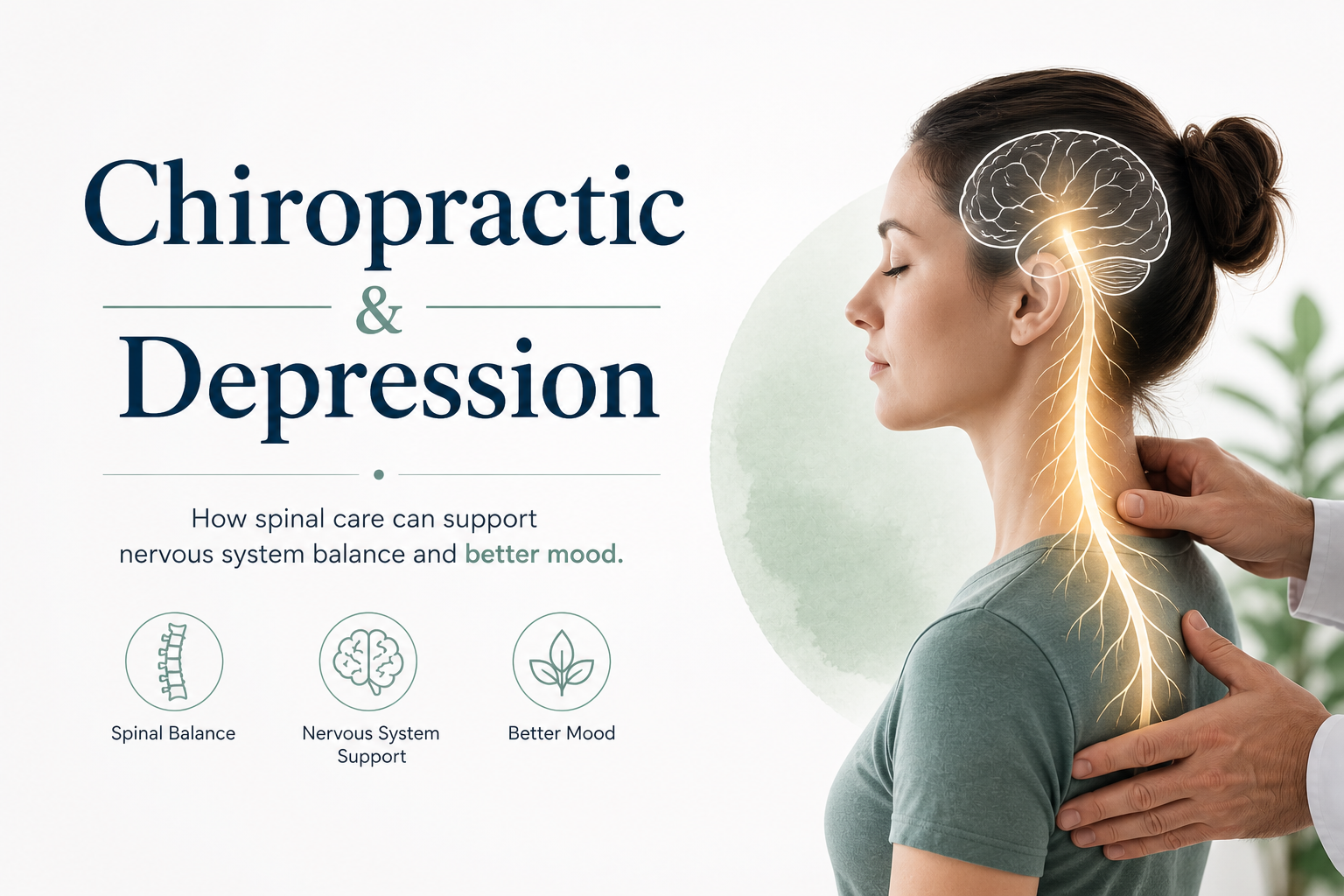
Depression is one of the most common and debilitating conditions on the planet. It is the fourth leading cause of disability worldwide according to the World Health Organization, and it impacts far more people than most realize including the majority of patients already dealing with chronic pain, with research showing that 50 to 65 percent of chronic pain sufferers also carry a diagnosis of depression.
Most people think of chiropractic care in terms of back pain and posture. But a 2020 review published in Acta Biomedica mapped out, for the first time in one place, the biological pathways that may explain how spinal adjustments could influence mood, anxiety, and depression. What the authors found connects chiropractic care to the same neurological and chemical systems that antidepressant medications target.
Depression Is a Nervous System Problem
Most people understand depression as a brain chemistry issue. But the research tells a more complete story: depression is also a nervous system imbalance, and that is where the chiropractic connection begins.
Your autonomic nervous system has two branches that should work in balance. The sympathetic branch is your fight-or-flight system; it raises heart rate, releases adrenalin and cortisol, and prepares your body for threat. The parasympathetic branch is your rest-and-digest system; it lowers heart rate, reduces inflammation, and supports healing and recovery. In depression, the sympathetic branch is chronically overactive while the parasympathetic branch is underactive. Nearly every hallmark symptom of depression, high cortisol, insomnia, anxiety and agitation, elevated heart rate, weight changes, increased cardiovascular risk, can be traced directly back to this pattern of sympathetic overdrive.
The question chiropractic researchers are now asking is whether restoring proper movement in the spine can shift this balance back toward parasympathetic dominance.
The Spine and Your Autonomic Nervous System
The cervical region of the spine, the neck, and the lumbar region of the lower back are not just structural anchors. They are key hubs through which the autonomic nervous system operates. The nerves that regulate your heart rate, breathing, digestion, and stress response all have direct connections through these spinal regions.
When the fight-or-flight response becomes chronically activated, it produces a pattern most people with depression will recognize immediately: persistent anxiety and an inability to relax, disrupted sleep and constant fatigue, elevated heart rate and blood pressure, high cortisol that suppresses mood and immune function, digestive problems, muscle tension, and headaches.
When the joints in these spinal regions are restricted or not moving properly, they do not just cause local pain or stiffness. Because of their direct connections to the autonomic nervous system, dysfunctional spinal segments can feed abnormal signals into the same autonomic pathways that regulate stress, mood, and arousal. A spine that is not moving well is not just a structural problem; it may be an ongoing source of nervous system stress that contributes to or worsens the autonomic imbalance underlying depression.
This is not a coincidence in the pain-depression overlap either. Depression and chronic pain share overlapping neurological pathways. Spinal adjustments that address pain, particularly for tension-type headache, appear to simultaneously improve depressive symptoms through these shared mechanisms. One published case report documented a 44-year-old teacher who experienced lasting relief from both tension-type headache and major depression following chiropractic manipulative therapy.
The Vagus Nerve: The Missing Link
One of the most compelling arguments in this research is the parallel between chiropractic care and vagus nerve stimulation, an established medical treatment for treatment-resistant depression that has been studied in over 3,000 clinical and pre-clinical trials since 2005.
The vagus nerve is the body's primary parasympathetic highway. It runs from the brainstem down through the neck, into the chest, and through the abdomen. About 85 percent of its fibers carry signals upward to the brain rather than downward, making it a powerful afferent communication pathway. It connects directly to the brain regions that regulate mood: the amygdala, prefrontal cortex, hippocampus, and anterior cingulate cortex.
Brain imaging studies on vagus nerve stimulation therapy have shown it activates these same depression-disrupted regions, increases serotonin and noradrenalin, and promotes neurogenesis in the hippocampus. In one 205-patient cohort study, 76.7 percent of participants maintained their positive response to vagal stimulation from three to 24 months, meaningful long-term outcomes from a therapy that works through this nerve pathway.
Because the vagus nerve passes directly through the cervical region of the spine, cervical chiropractic adjustments may stimulate vagal afferent fibers in ways that parallel the effects of vagus nerve stimulation therapy. This is the proposed mechanism, not that chiropractors are treating depression directly, but that the nervous system pathways activated by cervical adjustments overlap significantly with those activated by a well-researched, peer-reviewed depression treatment.
BDNF and NGF: The Brain's Repair Chemicals
Two proteins sit at the center of both depression research and the emerging science of chiropractic's neurological effects. The first is BDNF, brain-derived neurotrophic factor. Think of it as fertilizer for your neurons. It supports their survival, growth, and adaptability. It is consistently found at lower levels in the prefrontal cortex and hippocampus of depressed patients, and lower still in individuals with suicidal ideation. Antidepressant medications work partly by raising BDNF. Chiropractic manipulative therapy has been shown to stimulate BDNF release.
The second is NGF, nerve growth factor. Less well known but equally significant, NGF supports cholinergic and sympathetic neurons in the brain, helps regulate the body's primary stress-response system, and has demonstrated antidepressant properties in animal models. Lower NGF levels are found in the hippocampus of suicidal individuals. Research has shown that non-noxious mechanical stimulation of the skin, the kind produced during a chiropractic adjustment, promotes NGF release.
The significance of this is hard to overstate. Chiropractic adjustments stimulate the release of BDNF and NGF, the same neurotrophins that antidepressants are designed to raise, and the same chemicals that vagus nerve stimulation promotes. This places chiropractic adjustments within the same neurobiological framework as established depression treatments, not outside it.
What This Means and What It Doesn't
This research does not suggest that chiropractic care should replace antidepressant medication or psychotherapy. What it does suggest is that the nervous system effects of spinal adjustments are far broader than most people, including many clinicians, have assumed.
For patients dealing with both chronic pain and depression, chiropractic care may address both conditions simultaneously through their shared neurological pathways. For patients whose depression is rooted in chronic autonomic dysregulation, that pattern of sympathetic overdrive, adjustments may support the shift toward parasympathetic dominance that medication alone cannot always achieve. And for patients already using antidepressants or in therapy, chiropractic care alongside those treatments may support the same brain chemistry changes they are designed to produce.
It is important to be honest about what this paper is: a narrative review that synthesizes existing research and maps out biological mechanisms. It does not directly measure whether chiropractic care reduces depression scores in patients. The authors identify strong biological plausibility and call explicitly for direct randomized controlled trials to confirm these clinical outcomes. The science is promising. Larger studies are the necessary next step.
References
[1] Kiani AK, Maltese PE, Dautaj A, et al. Neurobiological basis of chiropractic manipulative treatment of the spine in the care of major depression. Acta Biomedica 2020;91(13-S). DOI: 10.23750/abm.v91i13-S.10536. PMC8023121.
[2] Budgell B, Hirano F. Innocuous mechanical stimulation of the neck and alterations in heart-rate variability in healthy young adults. Autonomic Neuroscience 2001;91(1-2):96-99.
[3] Nemeroff CB, et al. VNS therapy in treatment-resistant depression: clinical evidence and putative neurobiological mechanisms. Neuropsychopharmacology 2006;31(7):1345-1355.
[4] Marangell LB, et al. Vagus nerve stimulation for major depressive episodes: one year outcomes. Biological Psychiatry 2002;51(4):280-287.
[5] Duman RS, Heninger GR, Nestler EJ. A molecular and cellular theory of depression. Archives of General Psychiatry 1997;54(7):597-606.
[6] Karege F, et al. Neurotrophin levels in postmortem brains of suicide victims. Brain Research: Molecular Brain Research 2005;136(1-2):29-37.
[7] Haavik-Taylor H, Murphy B. Cervical spine manipulation alters sensorimotor integration. Clinical Neurophysiology 2007;118(2):391-402.
[8] Aloe L, et al. Nerve growth factor: from the early discoveries to the potential clinical use. Journal of Translational Medicine 2012;10:239.
[9] Levi-Montalcini R, et al. Nerve growth factor: from neurotrophin to neurokine. Trends in Neurosciences 1996;19(11):514-520.
This blog is for educational purposes and does not constitute medical advice. If you are experiencing depression, please speak with a qualified healthcare professional.


MAP
© 2026 Mind Body Spine Chiropractic. All Rights Reserved. Accessibility Statement - Privacy Policy - Terms and Services - Sitemap
Powered by: 