

Why Balance Is the Skill Your Golf Game Is Missing

Why Balance Is the Skill Your Golf Game Is Missing
When golfers want more distance, they think about swing speed. When they want more accuracy, they think about swing path. Balance rarely comes up, and that is a problem, because the research is clear: balance is one of the most important physical skills in golf, and most recreational golfers do not have enough of it.
The good news is that balance can be trained. And when it improves, almost everything else in your game improves with it.
What Balance Actually Does in the Golf Swing
Balance is your body's ability to stay in control of its own weight during movement. In golf, that means maintaining a stable platform while you rotate at speed, shift your weight from one foot to the other, and deliver the club to the ball consistently.
Here is a number that puts it in perspective: research by the Titleist Performance Institute found that over 60% of amateur golfers cannot balance on one leg for 10 seconds. That is the TPI's standard balance screen, a basic test, and most recreational players fail it. Compare that to professional golfers, who demonstrate significantly steadier weight control and far more consistent pressure patterns throughout the swing.
The difference between a PGA Tour player's footwork and an amateur's is visible on a pressure plate. Tour players start with their weight centered, smoothly shift to the trail foot on the backswing, then move decisively to the lead foot through the downswing, a controlled, deliberate wave of pressure that drives power. Amateur golfers' patterns tend to be erratic, shifting at the wrong times and in the wrong directions, losing energy at every step.
Balance and Power: They Go Together
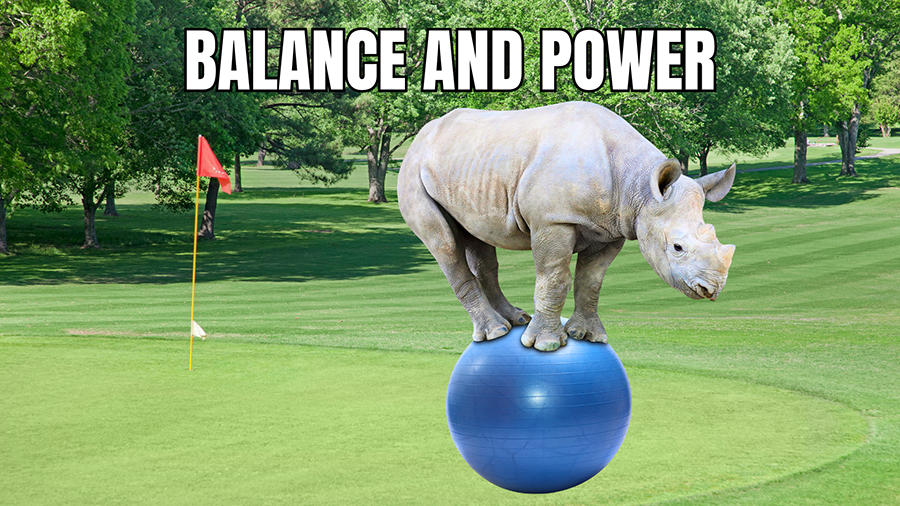
You may have heard the term "using the ground,” the idea that elite golfers push into the turf to generate power. Research confirms this is real. Peak vertical force during a driver swing can reach 1.6 times body weight in elite players. That force is then redirected upward through the body and into the club.
But here is the thing: you cannot push into the ground effectively if you are not balanced over it. An unstable base leaks power in every direction. The force you try to generate gets lost in sway, lateral drift, and compensatory movement. Balance is what allows you to load the ground and then use that load; it is not separate from power; it is the foundation of it.
When Balance Breaks Down: The Swing Faults It Creates
Poor balance does not cause a golfer to fall on the course. What it does is force the body to make small compensations, and those compensations are the swing faults that cost you strokes.
Sway happens when a golfer cannot confidently load the trail foot, so the whole body drifts laterally instead of rotating. Without that rotational coil, power is lost before the downswing even begins.
Reverse pivot is when a golfer's weight goes the wrong direction entirely, forward on the backswing and back through impact. This is often a balance issue: the brain does not feel secure loading onto the trail foot, so it avoids it.
Early extension is when the hips thrust toward the ball through impact. It is partly a hip mobility problem, but also a balance failure. As the body rotates toward the target on the lead foot, balance must be maintained on a rapidly shifting platform. When it cannot, the body falls toward the ball to catch itself.
Standing up through impact is when you lose your spine angle as you approach the ball. It is another common sign that the body is prioritizing balance over mechanics. The postural system overrides the swing.
All of these look like technique problems, and they are, but they are technique problems with a physical cause. Coaching them without addressing the balance deficit underneath is why so many swing changes do not stick.
Balance, Injury, and Your Back
Balance problems are not just a performance issue; they are a health issue.
A peer-reviewed study in the Journal of Sports Science and Medicine tested dynamic balance in elite college golfers and found that players with chronic low back pain scored significantly lower on balance assessments than pain-free golfers of the same skill level. The same group also had lower clubhead speed and altered swing mechanics.
This tells us something important: balance deficits and back pain are connected. A body that cannot control its balance during the swing places more stress on the lumbar spine, and a spine that is in pain loses some of the sensory input it needs to help maintain balance. The two conditions feed each other, which means treating the back alone without restoring balance is only part of the solution.
Balance and the Aging Golfer
If you have noticed your game becoming less consistent as you have gotten older, balance may be a bigger factor than you realize. The body's balance systems, particularly the inner ear's vestibular system, naturally decline with age. Research shows that by your seventies, the majority of people have measurable changes in vestibular function.
This does not mean your best golf is behind you. It means that balance training becomes more important, not less, as you get older. The research also shows that these systems respond to exercise; balance can be maintained and even improved with the right training, at any age.
A Simple Test You Can Do Right Now
Stand on one leg. No holding onto anything. Set a timer.
If you cannot reach 10 seconds, you have just identified one of the most significant physical limitations in your golf game, and one of the most fixable.
Good balance for golf means being able to load confidently onto either foot, shift your weight deliberately and on time, and maintain your posture through the full rotation of the swing. When all of that is working, your swing becomes more consistent, your power increases, and your body is under far less stress across a round.
What We Can Do
At our office, balance is part of how we assess every golfer we work with. Using movement screens and pressure analysis, we identify where balance is breaking down and what is causing it, whether that is a foot mechanics issue, a proprioceptive deficit, muscle weakness, or joint restriction.
From there, we build a plan to address it: manual therapy where joints need to be freed up, corrective exercises that train balance in golf-specific positions, and orthotic support where the foot foundation needs reinforcement.
Better balance means better shots, more power, and a body that holds up over 18 holes, and over many seasons to come.
References:
Deficits in the Star Excursion Balance Test and Golf Performance in Elite Golfers with Chronic Low Back Pain. Journal of Sports Science and Medicine. 2021. PMC8219274.
Ground Reaction Force and Centre of Pressure During the Golf Swing: A Systematic Review. Sports Medicine. Springer Nature. 2025.
Golfing Skill Level Postural Control Differences. Journal of Sports Science and Medicine. PMC3737932.
Foot–ground interaction and clubhead speed. Frontiers in Sports and Active Living. 2026.


MAP
© 2026 Mind Body Spine Chiropractic. All Rights Reserved. Accessibility Statement - Privacy Policy - Terms and Services - Sitemap
Powered by: 