

Tight Hips

Tight Hips Are Costing You Distance — and Possibly Your Back
When golfers lose distance or develop lower back pain, the first instinct is to look at the swing. But in many cases, the real problem is sitting deeper, literally. Tight hips are among the most common and consequential physical limitations in golf, and they affect far more than just how far you can turn.
The Hips Are the Engine of the Golf Swing
Power in the golf swing does not come from the arms. It comes from the ground up, through the feet, into the hips, through the core, and into the club. The hips sit at the center of that chain, and their job is to rotate powerfully and in the right sequence.
During the backswing, the trail hip loads, and the lead hip rotates, allowing the pelvis to coil. At the top, the hips begin unwinding toward the target before the shoulders follow, creating the separation between upper and lower body that generates speed. Through impact, the lead hip has to clear fully so the body can rotate through the ball.
Research on PGA Tour players shows they average more than 45 degrees of hip internal rotation on both sides. That mobility is not accidental — it is what makes the sequencing possible. And when it is missing, the body finds workarounds that cost you in two ways: your swing suffers, and your body takes a beating.
What Tight Hips Do to Your Swing
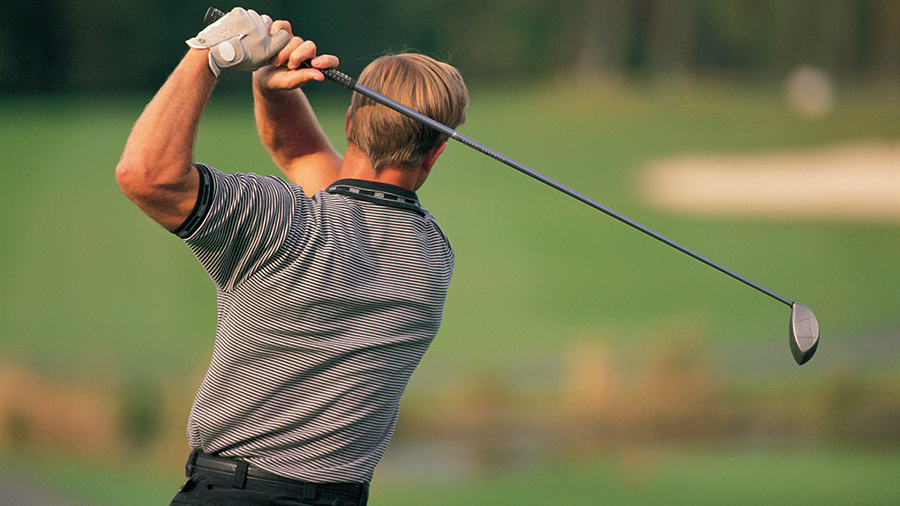
Early extension. This is the most common swing fault linked to restricted hip rotation. When the lead hip cannot clear properly, the pelvis has nowhere to go, so it thrusts toward the ball. You lose your posture, your impact position falls apart, and consistent ball-striking becomes nearly impossible.
Loss of power. Tight hips reduce the separation between your hips and shoulders at the top of the backswing, what biomechanists call the X-Factor. Less separation means less coil, less elastic energy stored, and less speed delivered at impact. No amount of arm effort can fully replace what is lost here.
Reverse spine angle. When the trail hip cannot rotate freely during the backswing, golfers often lean toward the target at the top to create the appearance of a full turn. This puts the lower back in a vulnerable position right when the forces of the downswing are at their peak.
Over-the-top swing path. When the hips cannot lead the downswing, the upper body takes over instead, throwing the club outside the ideal path and producing the pull-slice that frustrates so many recreational golfers.
What Tight Hips Do to Your Body
The swing faults above are performance problems. But tight hips also create injury patterns that can sideline you for weeks or months.
Lower back pain is the most common golf injury, affecting up to 50% of golfers. A major reason is that when the hips do not rotate enough, the lumbar spine compensates, rotating far beyond what it is designed to handle, under the significant forces of the swing. Research has directly linked restricted hip internal rotation to greater lumbar spine movement during the golf swing, and greater lumbar movement means greater injury risk.
Hip impingement (FAI) occurs when the ball of the hip joint repeatedly pinches against the socket rim. In golfers, this most commonly develops in the lead hip, which is under the greatest rotational demand through impact. Left untreated, it leads to labral tears and joint degeneration.
Knee stress is a less obvious consequence. When the hip stops rotating, the knee is often recruited to add extra turn, but the knee is a hinge joint, not a rotational one. Forcing it to rotate creates stress on the medial knee structures that accumulates over time.
Why Hips Get Tight
The main culprit is sitting. Most people spend the majority of their day in a chair, which progressively shortens the hip flexors and tightens the hip capsule. Add the repetitive, one-directional demands of golf and the pattern gets worse over time.
The encouraging part is that hip mobility responds well to targeted treatment. Manual therapy, soft tissue work, and specific corrective exercises can meaningfully restore rotation, and when they do, swing changes that previously felt impossible suddenly become natural.
The Key Takeaway
If you have a swing fault your coach keeps trying to fix without lasting success, or if lower back pain has become part of your golf routine, tight hips are worth investigating. In many cases, it is the physical restriction driving the problem, not a misunderstanding of technique.
We assess hip mobility as a standard part of our golf performance evaluation. When we find a restriction, we treat it, and we often see significant improvements in both how a golfer moves and how they feel on the course.
References:
Kim SB et al. Lumbopelvic kinematic characteristics of golfers with limited hip rotation. American Journal of Sports Medicine. 2015.
Vad VB et al. Low back pain in professional golfers: the role of associated hip and low back range-of-motion deficits. American Journal of Sports Medicine. 2004.
Kinematic relationship between rotation of lumbar spine and hip joints during golf swing. PMC4430877.
Low back pain and golf: A review of biomechanical risk factors. PMC9219256.


MAP
© 2026 Mind Body Spine Chiropractic. All Rights Reserved. Accessibility Statement - Privacy Policy - Terms and Services - Sitemap
Powered by: 