

Golf Upper Back

A Stiff Upper Back Is Quietly Wrecking Your Golf Swing
If you sit at a desk, drive a car, or spend time looking at a phone, and we all do, there is a good chance your upper and mid-back are stiffer than they should be. Most people write this off as general tightness or poor posture. For golfers, it is something more specific: it is one of the most common and most damaging physical limitations in the game.
The mid and upper back, called the thoracic spine, is designed to be the primary rotation engine of the golf swing. When it moves freely, the swing flows. When it is stiff, the body compensates in ways that cost you distance, consistency, and eventually your health.
Why the Mid-Back Matters So Much in Golf
A good golf swing requires significant rotation of the upper body relative to the lower body. That rotation, the shoulder turn, is supposed to come primarily from the thoracic spine. When it does, the lower back stays stable, the shoulders move freely, and the swing builds the coiled power that generates distance.
Research confirms that elite golfers who increase upper-back rotation during the backswing while keeping their hips relatively stable generate the highest clubhead speeds. The separation between shoulder turn and hip turn, known as the X-Factor, is one of the strongest predictors of power in the swing. And the X-Factor depends almost entirely on a mobile thoracic spine.
When the mid-back is stiff, that rotation has to come from somewhere else. And that is where the trouble starts.
What a Stiff Mid-Back Does to Your Swing
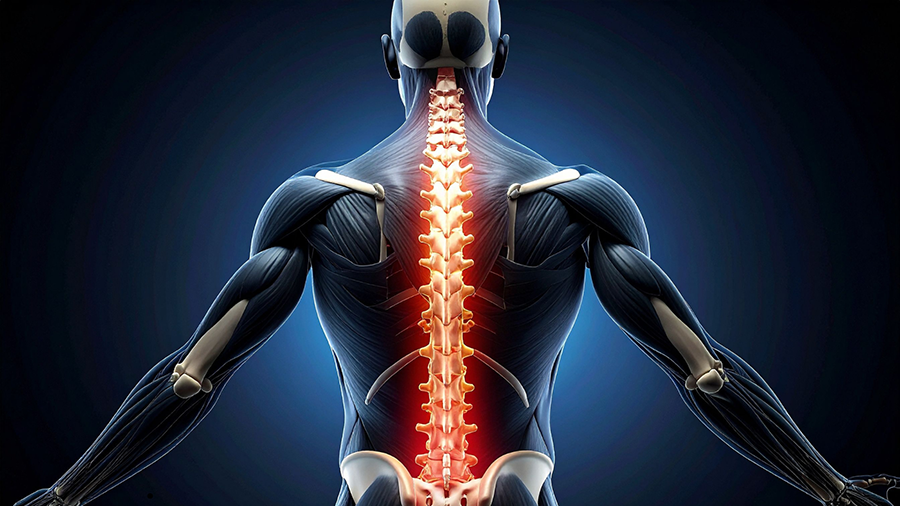
You lose your shoulder turn. Without adequate mid-back rotation, the backswing becomes short and flat. The club does not get where it needs to go, the X-Factor shrinks, and power disappears before the downswing even begins. Many golfers compensate by lifting their arms above the plane to create the illusion of a full turn, but it is not the same thing, and the swing knows it.
Your lower back overworks. The lumbar spine, your lower back, is built for stability, not rotation. It has a very small rotational range by design. When the mid-back stops rotating, the lower back is recruited to make up the difference, repeatedly twisting beyond what it is designed to handle. This is one of the most direct pathways to golf-related back pain, which affects up to 50% of golfers at some point.
Your posture sets you up to fail before you swing. Thoracic stiffness often produces a rounded upper back at address, what the Titleist Performance Institute calls "C-posture." This position mechanically locks the mid-back into flexion, making rotation almost impossible from the very start of the swing. Golfers with C-posture have a high rate of reverse spine angle, leaning toward the target at the top of the backswing, which is one of the leading causes of lower back injury in golf.
Your shoulders suffer. The shoulder blades sit on the upper back and depend on thoracic mobility to move properly. When the upper back is rounded and stiff, the shoulder blades cannot tilt and rotate freely, which narrows the space the rotator cuff tendons pass through. The result is shoulder impingement, a painful pinching that is among the most common golf injuries, particularly in the lead shoulder.
Your neck compensates. When the mid-back cannot rotate enough, the neck often tries to add extra turn to the backswing. The cervical spine is not designed to handle that kind of repetitive load, and upper neck pain, tension headaches, and stiffness in the upper trapezius are the frequent result.
Why This Happens to So Many Golfers
Modern life is the main culprit. Prolonged sitting places the thoracic spine in sustained forward flexion, the rounded position, for hours at a time. Over months and years, the joints stiffen in that position, and the muscles around them adapt to it. By the time most recreational golfers reach the course, they are already working against significant restriction before they take a single swing.
Add the repetitive one-direction demands of golf itself, thousands of swings that bias rotation toward one side, and the pattern gets worse over time rather than better.
The good news is that the thoracic spine responds well to treatment. Unlike some areas of the body that take months of work to improve, mid-back mobility often shows meaningful gains quickly with the right approach.
What We Can Do
Restoring thoracic mobility involves a combination of manual therapy to free up the stiff joints, soft tissue work on the tight muscles surrounding the upper back and chest, and targeted exercises to reinforce and maintain the improved range.
The key point is that improving mid-back mobility must come before swing coaching can fully take effect. If the physical restriction is still there, the body will keep finding the same workarounds, no matter how clearly the golfer understands what they are supposed to do. Fix the body first, and the swing changes become possible.
If your swing feels restricted, your lower back aches after golf, or your shoulder turn has never been what you wanted it to be, a thoracic mobility assessment is a great place to start. You may find that the problem is not your swing at all; it is simply your upper back asking for some help.
References:
The Swing Performance Index: Golf swing rotational biomechanics quantified with 3D kinematics. Frontiers in Sports and Active Living. 2022. PMC9816382.
The Golf Movement Screen and X-Factor in Low Handicap Golfers. PubMed PMID: 29979282.
Lumbar spine and low back pain in golf: a literature review. PubMed PMID: 17938007.
Titleist Performance Institute. Reverse Spine Angle. mytpi.com


MAP
© 2026 Mind Body Spine Chiropractic. All Rights Reserved. Accessibility Statement - Privacy Policy - Terms and Services - Sitemap
Powered by: 