

Golf Support Series
Your Body Is Your Most Important Piece of Golf Equipment: Introducing Our Golf Performance & Biomechanics Series
Most golfers invest heavily in their game. New drivers engineered to tighten dispersion. Irons fitted to their exact swing weight and lie angle. Lessons with teaching professionals analyzing their swing on video frame by frame. Training aids, launch monitors, premium balls, the pursuit of improvement drives a multi-billion dollar industry built on the promise of lower scores.
And yet, the single most important variable in golf performance is the one most golfers never think to address.
It is the body swinging the club.
No shaft, no fitting session, no swing tip can overcome a body that cannot move the way the golf swing demands. A driver fitted to a swing that is itself the product of compensation and restriction will perform better than a standard off-the-rack club, but it will never unlock the golfer's true potential, because the fundamental limitation is not the equipment. It is the physical capacity behind the swing.
This series exists to change that conversation.
“Its the archer, not the arrow”
The Golf Swing Is a Physical Act First
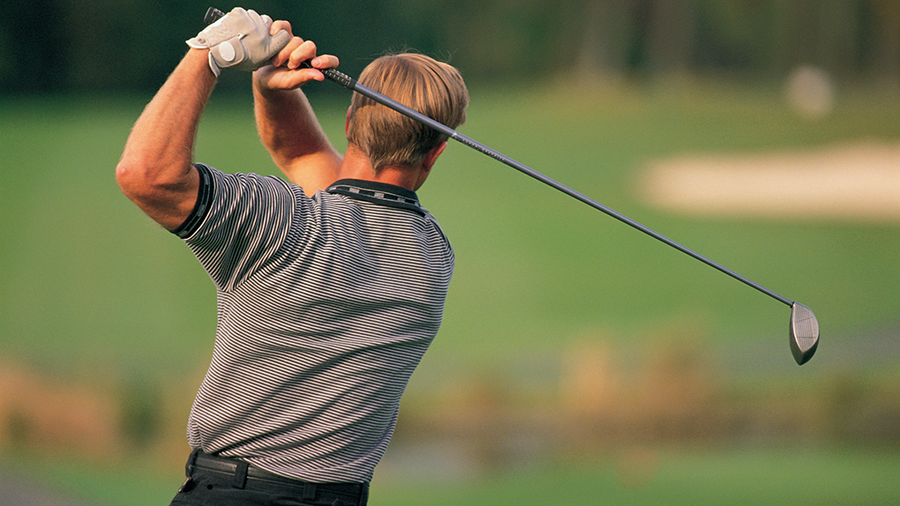
The golf swing looks like a technique. In coaching environments it is taught as one, grip, stance, takeaway, top of the backswing, transition, impact, follow-through. Each position is refined, each movement is shaped through practice and repetition.
But underneath every technique is a body. And a body that cannot achieve certain positions, generate certain movements, or maintain postural control under load will find workarounds, compensatory patterns that protect it from the demands it cannot meet. Those compensatory patterns are what instructors call swing faults. They are also what clinicians call injury mechanisms.
The slice that plagues a golfer for years may not be a misunderstanding of swing path. It may be a restricted thoracic spine that prevents the upper body from sequencing properly. The loss of distance a golfer notices in their late forties may not be aging in the general sense, it may be specific, measurable declines in hip internal rotation and balance that reduce the power available at every step of the kinetic chain. The chronic lower back pain that shortens careers and limits practice time may not be an inevitable consequence of playing golf, it may be the predictable result of asking a lumbar spine to rotate beyond its design limits because the structures above and below it cannot do their jobs.
Golf is a physical act. The body is the instrument. And like any instrument, it performs at the level its structure and condition allow.
The Kinetic Chain: Why Every Body Segment Matters
The concept at the foundation of this series is the kinetic chain, the linked sequence of body segments through which force is generated, transferred, and delivered to the golf club.
The swing begins at the ground. The feet press into the turf, generating ground reaction forces that travel upward through the ankles, knees, hips, core, thoracic spine, shoulders, arms, and finally the clubhead. Each segment in this chain has a role to play: generate force, transfer it efficiently to the next link, and receive it from the link below. When every segment functions well, the chain transmits maximum energy to the ball with minimal waste and minimal strain on any individual structure.
When a link in the chain is compromised, when a segment is restricted, weak, unstable, or poorly coordinated, the chain does not simply transmit less energy. It reorganizes itself. Adjacent segments compensate. Structures absorb loads they were not designed for. The swing fault and the injury risk emerge from the same root cause: a body that cannot execute the movement as designed, doing its best to produce the result anyway.
This is why you cannot address one part of the body in isolation. The lumbar spine hurts because the thoracic spine and hips are not rotating. The shoulder impinges because the thoracic spine is kyphotic and the scapula cannot move freely. The club face is open at impact because the wrist lacks the extension range to maintain a neutral position at the top of the backswing. Every symptom, whether a swing fault or a pain pattern, has a physical story behind it, and that story runs through the kinetic chain.
Understanding that chain, and understanding what each of its major links contributes, is the foundation of this series.
About This Series
What follows is a collection of in-depth articles examining the major physical contributors to golf performance and injury, one body region at a time. Each article is grounded in peer-reviewed research, biomechanical analysis, and clinical experience. The goal is not to replace your swing coach or Dr. Singleton, but to give you, the golfer, the knowledge to understand why your body moves the way it does, and what can be done to help it move better.
Here is a preview of what each article in the series covers.
The Foundation: Your Feet, Orthotics, and Golf Performance
The feet are the only part of the body in contact with the ground throughout the entire golf swing. They are the starting point of the kinetic chain and the sensory foundation of balance, packed with proprioceptive nerve endings that feed real-time position information to the brain. Yet they are almost universally ignored in golf performance conversations.
This article examines the biomechanical demands placed on the feet during the swing, what the research shows about how foot mechanics influence everything above them, and the specific evidence behind Foot Levelers custom orthotics in golf, including the landmark research by Stude and Gullickson showing a 29–36% increase in pelvic rotation and a 3–5 mph gain in clubhead speed with orthotic use. We break down the three-arch plantar vault concept, explain how pronation and supination contribute to the swing at each phase, and identify which golfers are most likely to benefit from orthotic intervention.
The Engine: Hip Rotation, Power Generation, and the Cost of Tight Hips
The hips sit at the center of the kinetic chain and are the primary power generator of the golf swing. Understanding what the hips are supposed to do, and what happens when they cannot, is essential knowledge for any golfer who wants to improve their distance, their consistency, or their long-term joint health.
This article covers the biomechanics of lead and trail hip function through each phase of the swing, the X-Factor and why it depends on hip mobility, and what peer-reviewed research, including the landmark Kim et al. study in the American Journal of Sports Medicine, shows about golfers with restricted hip internal rotation. We explore the swing faults that emerge from tight hips (early extension, reverse spine angle, over-the-top sequencing) and the injury patterns that follow (lumbar disc pathology, femoroacetabular impingement, knee stress), and explain why fixing the swing fault without addressing the physical restriction is a battle that cannot be won.
The Rotational Engine: Thoracic Spine Mobility and the Swing
If the hips are the engine of the golf swing, the thoracic spine is the transmission, the structure through which lower-body rotational power is converted into upper-body speed and delivered to the club. Without adequate thoracic mobility, the X-Factor collapses, the sequencing breaks down, and the structures above and below the thorax are forced to absorb what it cannot provide.
This article examines why the thoracic spine is the body's most important rotational segment, what optimal thoracic mobility looks like and what the research establishes as normative values in competitive golfers, and how restrictions in this region produce a cascade of dysfunction across the body. We cover C-posture and S-posture, the most common thoracic-related swing faults, and the downstream injury consequences, from lumbar disc pathology to rotator cuff impingement to cervical spine strain, that emerge when the thorax stops moving. The joint-by-joint stability-mobility principle provides the framework for understanding why every rigid thoracic segment costs two adjacent structures their designed function.
The Platform: Balance, Ground Reaction Force, and Performance
Balance is the invisible skill that separates professional golfers from amateurs at every level of the game, and the one physical quality most golfers have never deliberately trained. Research shows that elite golfers maintain significantly less center of mass displacement during the swing than their recreational counterparts, generate and control ground reaction forces more effectively, and demonstrate superior dynamic postural control under the fatiguing demands of a full round.
This article examines the three sensory systems, proprioceptive, vestibular, and visual, that combine to produce postural control, what peer-reviewed research (including the Star Excursion Balance Test studies and the 2025 Sports Medicine systematic review on ground reaction forces) tells us about the relationship between balance and clubhead speed, and how specific balance failures produce specific swing faults. We also address the aging golfer's often-unrecognized vestibular decline, the relationship between balance deficits and chronic low back pain in elite players, and what the research shows about improving balance through targeted training.
Our aim throughout is simple: to give golfers the knowledge to see their swing not as a technique problem to be coached into submission, but as a physical expression of a body that can be understood, assessed, and improved. Better movement produces better golf. And better golf, played in a well-functioning body, is a game that can be enjoyed for a lifetime.
Let's get to work.


MAP
© 2026 Mind Body Spine Chiropractic. All Rights Reserved. Accessibility Statement - Privacy Policy - Terms and Services - Sitemap
Powered by: 