

A Thanksgiving Warning: Why the Holidays Bring More Back Pain (and What You Can Do About It
It Happens Every Year…
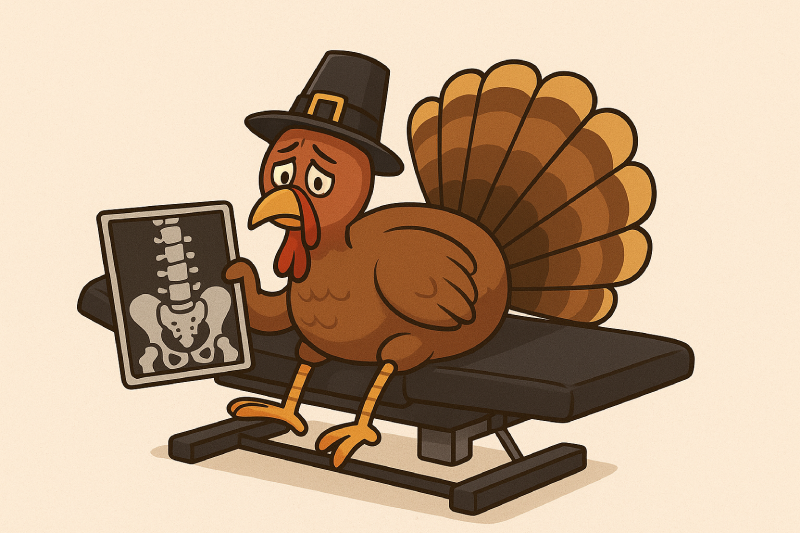
At Mind Body Spine Chiropractic, we’ve noticed an interesting pattern over the last 25 years: Thanksgiving through Christmas consistently brings the highest number of acute low back pain cases in our office.
What’s surprising is that most of these patients didn’t injure themselves lifting a turkey or decorating the tree. Instead, they simply wake up one morning with debilitating low back pain — unable to stand, walk, or even tie their shoes.
So, what causes this mysterious spike in back pain during the holidays?
The answer lies in one word: stress.
How Stress and the Holidays Affect Your Low Back
For many people, the holiday season is the most stressful time of the year. Between family gatherings, financial pressure, travel plans, big meals, alcohol, and less sleep, it’s easy to see why our nervous systems become overwhelmed.
When stress levels rise, your body releases hormones like cortisol and adrenaline, produced by your adrenal glands — two small but powerful organs that sit on top of your kidneys. These glands are responsible for helping your body respond to stress and maintain balance.
But here’s where chiropractic physiology connects the dots:
The nerves that regulate your adrenal glands originate from the lower thoracic and upper lumbar regions of your spine (T11–L2). When your body experiences chronic stress, those spinal segments can become overstimulated, leading to tight muscles, joint restriction, and pain in the lower back.
It’s like plugging too many appliances into one outlet — eventually, the circuit trips.
Your nervous system does the same thing under excessive stress.
The Mind-Body-Spine Connection
At Mind Body Spine Chiropractic, we take an integrated approach to health — looking at the nervous system, organ function, and musculoskeletal system as one connected unit.
This approach is rooted in the meric system, an early chiropractic model describing how each spinal level connects to specific organs through the nervous system.
For example:
The T11–L2 region influences the adrenal glands and kidneys, key regulators of stress and energy.
The L3–L5 segments impact the large intestine, reproductive organs, and muscles of the lower back.
When an organ is under stress (like the adrenals during the holidays), it can reflexively affect the spinal segments that share its nerve supply — a phenomenon known in neuroscience as a viscerosomatic reflex.¹ ²
This means that your back pain may not be from a pulled muscle, but rather from stress overload in your nervous system.
The Winsor Autopsy Study: Early Clues About Organ-Spine Connections
One of the earliest explorations of this connection came from Dr. Henry Winsor, a physician at the University of Pennsylvania in the early 1900s. In his famous Winsor Autopsy Study, he examined human cadavers to see whether diseased organs corresponded with changes in nearby spinal segments.³
His findings?
In the majority of cases, spinal curvatures and soft tissue changes appeared at the same levels as diseased organs.
While Winsor’s research predates modern scientific methods, it laid the foundation for understanding the close relationship between organ function and spinal health. Modern research in neurophysiology and viscerosomatic reflexes now confirms that the spine and internal organs communicate continuously — and when one system is under strain, the other compensates.⁴ ⁵
This supports what chiropractors observe every holiday season: stress and organ imbalance can show up as back pain, even without trauma.
Why the Holidays Are the Perfect Storm for Back Pain
Between Thanksgiving and New Year’s, most people face a combination of physical, emotional, and chemical stressors that push their bodies past the limit.
Let’s break it down:
Emotional stress: family tension, packed schedules, and unrealistic expectations.
Physical stress: long car rides, sitting for hours, decorating, shopping, and sleeping in unfamiliar beds.
Chemical stress: sugar, caffeine, alcohol, and nutrient-poor foods.
Sleep disruption: late nights, travel fatigue, and poor recovery.
All of these feed directly into the sympathetic nervous system (your fight-or-flight mode), tightening muscles, restricting circulation, and keeping your body on alert.
Eventually, the muscles and joints of your lower back — one of the body’s main “stress hubs” — become the outlet for all that accumulated tension.
How to Protect Your Back and Nervous System This Holiday Season
You can’t avoid all holiday stress, but you can prepare your body to handle it better.
Here’s your Holiday Survival Guide from Mind Body Spine Chiropractic:
1. Do a Stress Audit
List the top things that stress you out during the holidays — travel, finances, shopping crowds, or family dynamics.
Once you identify them, plan simple workarounds or support strategies.
As the saying goes, “Garbage in, garbage out.” Reducing your stress input lightens your body’s output.
2. Build Your “Stress-Relief Quiver”
Create a short list of quick, healthy stress-relief tools you can turn to anytime.
Your list might include:
Deep breathing or mindfulness
Stretching or walking
Journaling or gratitude practice
Listening to music or laughing with friends
Short workouts or dancing
Even two minutes of relaxation can reset your nervous system.
3. Stay Hydrated and Prioritize Sleep
Fatigue and dehydration magnify stress. Aim for 7–8 hours of sleep and steady hydration throughout the day to support your adrenals and spinal discs.
4. Maintain Regular Chiropractic Care
Routine chiropractic adjustments help reduce tension in your spine and nervous system, allowing your body to adapt to stress more effectively.
By keeping your spine in alignment, you ensure your nervous system, adrenal glands, and lower back can handle the holiday chaos with ease.
Final Thoughts: Listen to What Your Back Is Telling You
If your back “goes out” this Thanksgiving and you can’t pinpoint an injury, remember — your body isn’t broken. It’s just overloaded.
By managing stress, supporting your adrenal glands, and keeping your spine aligned, you can stay healthy, energetic, and pain-free through the holidays and beyond.
At Mind Body Spine Chiropractic, we’re here to help you do exactly that.
Schedule Your Pre-Holiday Adjustment Today
Don’t wait until you’re hobbling into the office after Thanksgiving dinner.
Book your holiday wellness adjustment at Mind Body Spine Chiropractic today — and give your spine the care it deserves this season.
📞 Call OR Text 508-896-7277
🌐 Book Online: https://www.mindbodyspinechiro.com/request-an-appointment.html
References
- StatPearls. Physiology, Viscerosomatic Reflexes. NCBI, 2023.
- Sikandar, S. et al. Visceral Pain: The Ins and Outs. Neuroscience & Biobehavioral Reviews, 2018.
- Winsor, H. Sympathetic Segmental Disturbances. University of Pennsylvania Medical Bulletin, 1921.
- Beal, M.C. Viscerosomatic Reflexes: A Review. Journal of the American Osteopathic Association, 1985.
- World Health Organization. Low Back Pain Fact Sheet, 2023.


MAP
© 2026 Mind Body Spine Chiropractic. All Rights Reserved. Accessibility Statement - Privacy Policy - Terms and Services - Sitemap
Powered by: 